
Landing Page Best Practices: 12 Ways to Increase Conversions in 2026
A successful landing page does more than attract visitors. It guides them toward a specific action, whether that means signing up for a newsletter, downloading a resource, requesting a quote, or purchasing a product.
However, getting visitors to a page is only half the challenge. If your landing page loads slowly, delivers an unclear message, or makes the next step difficult, potential customers may leave without taking action.
The solution is to combine effective landing page design, persuasive content, mobile optimization, and reliable marketing measurement.
In this guide, we'll explore 12 landing page best practices to help you create high-converting pages, improve the visitor experience, and understand which marketing channels generate meaningful results. We'll also explain how URL shorteners, branded links, and UTM parameters can help you measure the performance of your campaigns.
Key Takeaways
- Give every landing page one primary goal and a clear call to action (CTA).
- Match your headline and page content to the advertisement, email, or social media post that brings visitors.
- Use a simple layout with clear headings, readable content, and minimal distractions.
- Optimize images, scripts, and mobile performance to reduce loading times.
- Add authentic testimonials, customer reviews, and trust signals.
- Use short, descriptive URLs to make marketing links easier to share.
- Add UTM parameters to identify traffic sources and campaign performance.
- Test different headlines, images, and CTA placements to improve conversions.
- Measure actual conversions rather than relying on page views and clicks alone.
1. Start With One Clear Conversion Goal
The first step in creating an effective landing page is deciding exactly what you want visitors to do.
A landing page should have one primary objective. Trying to promote several unrelated offers simultaneously can confuse visitors and reduce the likelihood of completing the desired action.
Common landing page goals include:
- Collecting email subscribers.
- Generating business leads.
- Promoting a product or service.
- Encouraging visitors to register for an event.
- Offering a free download or digital resource.
- Scheduling consultations or product demonstrations.
For example, if you're promoting a free marketing guide, the page should focus on downloading that guide rather than presenting several unrelated products.
Practical tip: Define your conversion goal before writing the headline, designing the page, or choosing the CTA. Every major element should support that objective.
2. Write Headlines That Match Visitor Expectations
Your headline is often the first thing visitors notice. It should immediately explain what the page offers and why someone should continue reading.
One common landing page mistake is creating a headline that doesn't match the advertisement or link that brought the visitor to the page.
Imagine someone clicks an advertisement promising a free SEO checklist. If the landing page opens with a general description of a digital marketing agency, the visitor may feel that they landed in the wrong place.
This is known as poor message matching.
To improve your headline:
- Explain the main benefit clearly.
- Use simple language instead of complicated marketing terminology.
- Include your primary keyword naturally when relevant.
- Match the promise made in the original advertisement.
- Avoid exaggerated claims that your offer cannot support.
Example:
Weak headline: Welcome to Our Marketing Platform.
Better headline: Improve Your Website Rankings With Our Free SEO Checklist.
The second headline communicates a specific benefit and tells visitors what they can expect.
3. Use a Simple and Conversion-Focused Layout
A high-converting landing page should make it easy for visitors to understand the offer and take action.
You don't need complicated animations, excessive graphics, or dozens of content sections. A straightforward structure often works better.
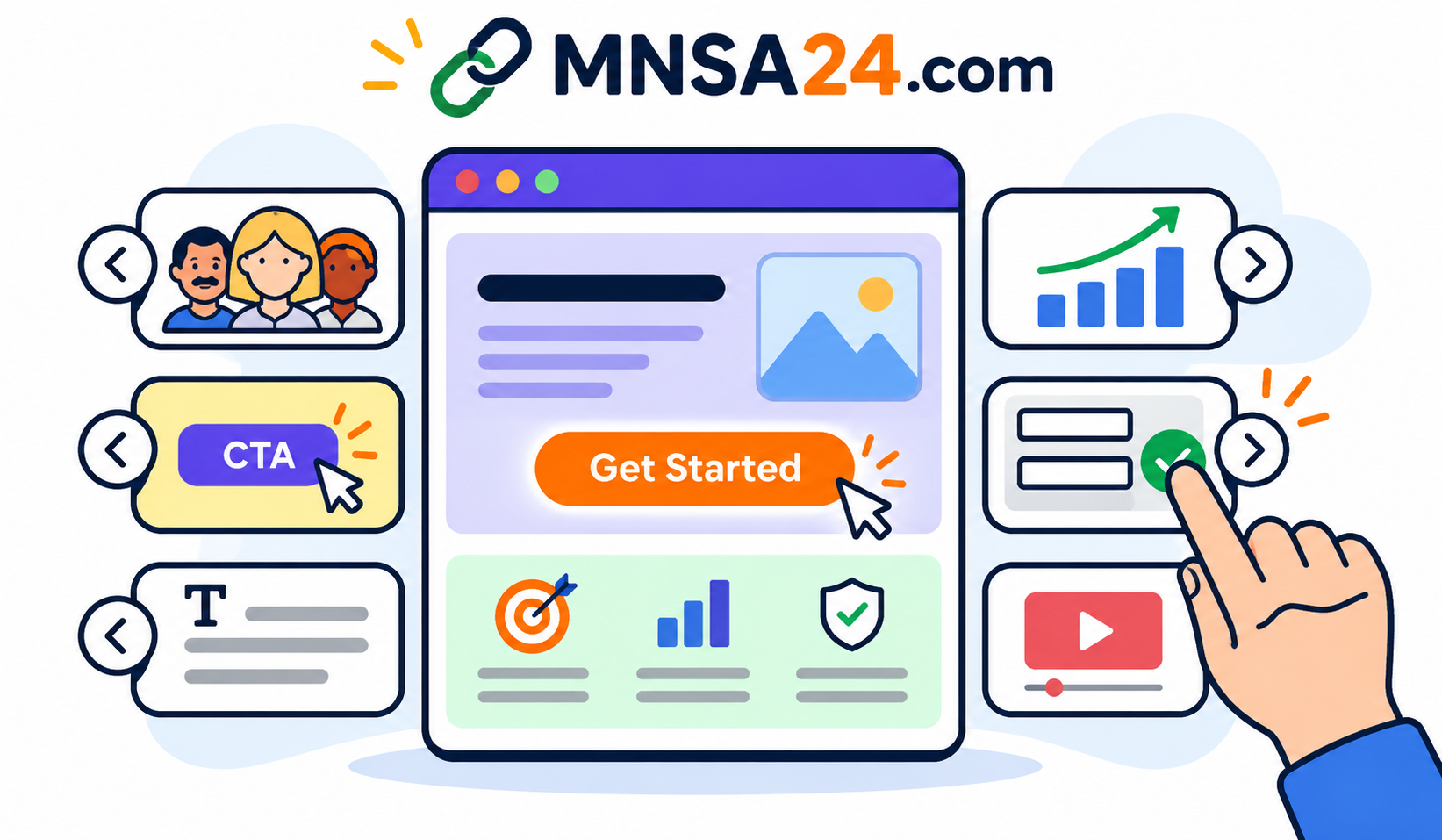
Consider using the following layout:
- Brand logo and identity.
- A benefit-focused headline.
- A short supporting description.
- One prominent CTA button.
- A relevant hero image or product demonstration.
- Three to five key benefits.
- Customer testimonials or other trust signals.
- Frequently asked questions.
- A final CTA.
Keep the most important information near the top of the page, where visitors can see it without scrolling.
For longer landing pages, repeat the same primary CTA at relevant points rather than introducing competing actions.
4. Create Strong Calls to Action (CTAs)
A call to action tells visitors what to do next.
A weak CTA creates uncertainty, while a specific CTA communicates the benefit of taking action.
Compare these examples:
| Weak CTA | Better CTA |
|---|---|
| Submit | Create Your Free Account |
| Click Here | Download the Free Guide |
| Learn More | Explore Our Features |
| Sign Up | Start Your Free Trial |
| Continue | Get Your Personalized Quote |
Your CTA should be:
- Easy to understand.
- Visually noticeable.
- Relevant to the page's main objective.
- Written using action-oriented language.
- Consistent throughout the visitor journey.
Avoid displaying several competing buttons with different objectives. Give visitors one obvious next step.
5. Optimize Your Landing Page for Mobile Devices
Mobile optimization is essential because visitors frequently discover products and services through smartphones.
A page that looks excellent on a desktop computer may become difficult to use on a smaller screen.
Common mobile problems include oversized images, small text, buttons that are difficult to tap, horizontal scrolling, and forms that require too much information.
Follow these mobile optimization practices:
- Use responsive layouts that adapt to different screen sizes.
- Choose readable font sizes.
- Make buttons large enough to tap comfortably.
- Compress images without noticeably reducing their quality.
- Keep forms short and straightforward.
- Avoid intrusive pop-ups.
- Test your page on different smartphones and browsers.
Pay particular attention to the first screen. Visitors should quickly understand the offer and find the primary CTA without unnecessary scrolling.
6. Improve Page Loading Speed
Page speed affects the visitor experience and can influence how effectively a landing page converts.
A slow page creates unnecessary friction, particularly for visitors using mobile networks.
Google's Core Web Vitals provide three important performance measurements:
| Metric | What It Measures | Good Target |
|---|---|---|
| Largest Contentful Paint (LCP) | Loading performance | 2.5 seconds or less |
| Interaction to Next Paint (INP) | Responsiveness | 200 milliseconds or less |
| Cumulative Layout Shift (CLS) | Visual stability | 0.1 or less |
These are Google's recommended good-performance thresholds, measured at the 75th percentile of page loads.
To improve performance:
- Compress large images.
- Use modern image formats such as WebP or AVIF.
- Reduce unnecessary JavaScript.
- Avoid excessive third-party scripts.
- Use browser caching where appropriate.
- Choose reliable hosting.
- Minimize unnecessary redirects.
- Test performance regularly using Google PageSpeed Insights.
Remember that a fast landing page is not simply a technical achievement. It removes obstacles between visitors and the action you want them to complete.
7. Build Trust With Reviews and Social Proof
Visitors are more likely to consider an offer when they have reasons to trust the business behind it.
Social proof helps reduce uncertainty by showing that other customers have interacted with your brand.
Useful trust elements include:
- Genuine customer testimonials.
- Verified product reviews.
- Recognizable customer logos, when authorized.
- Case studies with measurable results.
- Transparent pricing and service information.
- Clear contact details.
- Privacy and security information.
Place relevant trust signals near important decision points, particularly around registration forms and purchase buttons.
Avoid fabricated testimonials, misleading statistics, or unsupported performance claims. Trust is difficult to establish and easy to lose.
8. Keep Forms Short and Easy to Complete
Every additional form field creates another step for visitors to complete.
If your objective is to collect email subscribers, requesting a full name, phone number, company address, job title, and other unnecessary information may discourage registrations.
Instead, request only the information required for the next step.
For example:
Newsletter registration:
- Email address.
Business inquiry:
- Name.
- Email address.
- Short description of the request.
Product demonstration:
- Name.
- Business email.
- Company name.
- Relevant business information.
Explain why you collect personal information and provide an accessible privacy policy.
The objective is to make the registration process as straightforward as possible without collecting more information than you actually need.
9. Match Landing Pages to Their Traffic Sources
Not all visitors arrive with the same expectations.
Someone clicking a Google search advertisement may be actively comparing products, while someone arriving from Instagram may be discovering your brand for the first time.
Your landing page should reflect the visitor's original context.
| Traffic Source | Visitor Expectations | Recommended Approach |
|---|---|---|
| Google Ads | A specific answer or offer | Match the advertisement and keyword |
| Facebook and Instagram | Engaging visual content | Use strong visuals and concise copy |
| TikTok | Quick information and entertainment | Present the offer immediately |
| Professional information | Highlight business benefits and credibility | |
| Email Marketing | Relevant information from a known brand | Repeat the email's offer and message |
| Organic Search | Useful answers and information | Provide relevant, detailed content |
| QR Codes | Immediate access through a smartphone | Use a fast, mobile-friendly destination |
One important consideration is message consistency.
If an advertisement promotes a discount, the landing page should clearly display that same discount and explain its conditions.
A mismatch between the original message and the destination page can lead to abandoned visits.
10. Use Short Links and UTM Tracking to Measure Campaigns
An effective landing page strategy requires more than a good design. You also need to understand where visitors come from and which campaigns generate results.
This is where URL shorteners and UTM tracking become useful.
Long URLs containing multiple tracking parameters can look complicated and difficult to share.
A URL shortener converts a long destination URL into a shorter, easier-to-share link.
For example:
Long URL:
https://example.com/landing-page?utm_source=facebook&utm_medium=social&utm_campaign=summer2026
Short URL:
https://mnsa24.com/your-link
The short link provides a cleaner sharing experience while directing visitors to the original destination.
For campaign tracking, consider the following workflow:
Step 1: Create your landing page.
Publish the page you want visitors to reach.
Step 2: Add UTM parameters.
UTM parameters help identify the source, medium, campaign, and sometimes the specific advertisement or content variation.
Common UTM parameters include:
- utm_source: Identifies the traffic source, such as facebook or newsletter.
- utm_medium: Identifies the marketing channel, such as social, email, or cpc.
- utm_campaign: Identifies the campaign name.
- utm_content: Distinguishes between different advertisements or creative variations.
Step 3: Create a short link.
Use MNSA24 to create a shorter URL for your tracked destination. Make sure the URL shortener preserves the original destination and its UTM parameters.
Step 4: Use separate links for different placements.
Create different short links for Facebook posts, Instagram campaigns, email newsletters, and other promotional channels.
Step 5: Compare the results.
Use your website analytics platform to review sessions and conversions by campaign. If your URL shortening service provides click analytics, compare those clicks with the results recorded on your landing page.
This approach helps you understand which marketing activities deserve more attention.
Importantly, link clicks are not the same as conversions. A campaign that generates many clicks may still produce very few customers.
11. Run A/B Tests to Improve Conversion Rates
A/B testing allows you to compare two versions of a landing page to determine which performs better.
Instead of relying entirely on personal opinions, you can use actual visitor behavior to make design decisions.
You can test different elements, including:
- Headlines.
- CTA wording.
- Button placement.
- Hero images.
- Page layouts.
- Form length.
- Supporting descriptions.
For example:
Version A: Start Your Free Account.
Version B: Create Your Account in Minutes.
Both versions target the same action but use different messaging.
A practical testing process:
- Identify one element you want to improve.
- Create two versions of the landing page.
- Assign visitors to the versions using a suitable testing platform.
- Keep traffic conditions reasonably comparable.
- Measure completed conversions.
- Select the stronger version when the data is sufficient.
You can create separate MNSA24 short links for different campaign placements to help organize and compare incoming link traffic.
However, a shortener alone does not automatically perform a statistically valid A/B test. You need an appropriate traffic-splitting or experimentation tool for that purpose.
Change one major variable at a time whenever possible. Testing too many elements simultaneously makes it difficult to identify what actually influenced the result.
12. Measure the Metrics That Matter
Landing page performance should be evaluated using business outcomes rather than traffic numbers alone.
A page can receive thousands of visitors and still fail to generate meaningful results.
Focus on these important metrics:
| Metric | What It Tells You |
|---|---|
| Page Views | How many times the page was viewed |
| Unique Visitors | How many individual visitors arrived |
| Conversion Rate | The percentage of visitors who completed the desired action |
| Bounce or Engagement Metrics | How visitors interact with the page, depending on the analytics platform |
| Click-Through Rate (CTR) | How often visitors click a specific link or CTA |
| Cost Per Lead (CPL) | How much it costs to generate a lead |
| Customer Acquisition Cost (CAC) | How much it costs to acquire a customer |
| Traffic Sources | Which channels bring visitors to the page |
For example, imagine two advertising campaigns:
- Campaign A generates 2,000 visits and 40 conversions.
- Campaign B generates 1,000 visits and 60 conversions.
Campaign A has more traffic, but Campaign B produces a higher conversion rate.
Campaign A conversion rate: 2%.
Campaign B conversion rate: 6%.
This illustrates why traffic volume alone is not a reliable measure of marketing success.
Combine website analytics, conversion data, and short-link performance information to understand the complete visitor journey.
Common Landing Page Mistakes to Avoid
Even a well-designed landing page can underperform when basic mistakes create unnecessary friction.
Watch out for these problems:
Too many competing offers: Multiple primary actions make it difficult for visitors to decide what to do.
Unclear headlines: Visitors should not have to guess what your product or service offers.
Slow loading times: Large images and unnecessary scripts can negatively affect the user experience.
Poor mobile design: A page that is difficult to navigate on a smartphone can lose potential customers.
Excessive form fields: Requesting unnecessary personal information creates friction.
Missing trust signals: Visitors need clear reasons to believe your claims and trust your business.
Broken links and redirects: Always test your destination URLs and short links before publishing a campaign.
No conversion tracking: Without reliable measurement, you cannot confidently identify which changes improve performance.
Ignoring campaign attribution: If every promotional channel uses the same untracked link, identifying the source of successful conversions becomes more difficult.
How MNSA24 Fits Into Your Landing Page Marketing Strategy
A landing page is only one part of a successful digital marketing campaign. You also need an effective way to distribute its URL across different channels.
MNSA24 helps simplify that process by providing a URL shortening solution for creating and sharing shorter links.
Instead of distributing long destination URLs everywhere, you can create a more compact link and use it across:
- Social media posts and profiles.
- Email marketing campaigns.
- Digital advertisements.
- Website articles and resources.
- Printed promotional materials.
- QR Code campaigns.
For better campaign organization, use descriptive link names and maintain consistent UTM tracking conventions.
Before launching an important campaign, test the short link on desktop and mobile devices to confirm that it redirects to the correct landing page.
A simple workflow connecting your landing page, short links, and analytics platform can make your marketing campaigns easier to organize and evaluate.
The goal is not simply to generate more clicks. It is to understand which clicks lead to meaningful actions.
Final Thoughts: Turn More Landing Page Visitors Into Customers
Effective landing page optimization combines clear messaging, focused design, mobile performance, trust, and accurate measurement.
Start with one conversion goal, communicate the value of your offer, and make the next step obvious. Then use testing and analytics to understand what works and where visitors experience difficulties.
Don't overlook the role of link management in this process. Short, recognizable URLs make campaigns easier to share, while UTM parameters help identify the traffic sources that contribute to your results.
With a well-structured landing page and a consistent link management strategy, you can build more effective digital marketing campaigns.
Ready to simplify the links you share? Use MNSA24 to create shorter URLs for your landing pages, organize your promotional links, and make your next marketing campaign easier to manage.
Visit MNSA24.com and get started today.
Frequently Asked Questions
1. What are the best landing page best practices?
The most effective landing page practices include using one clear conversion goal, writing a benefit-focused headline, creating a strong CTA, optimizing for mobile devices, improving page speed, adding genuine social proof, and measuring conversions.
2. What makes a landing page convert better?
A landing page converts better when visitors immediately understand the offer, trust the business, and can complete the desired action without unnecessary steps. Clear messaging and a focused layout are essential.
3. How many CTAs should a landing page have?
A landing page should generally focus on one primary conversion goal. You can repeat the same CTA throughout a longer page, but avoid introducing competing actions that distract visitors.
4. What is a good landing page conversion rate?
There is no universal conversion rate that applies to every industry or campaign. Results depend on the offer, audience, traffic source, and conversion objective. Compare your landing page against its historical performance and relevant industry benchmarks.
5. How can I make my landing page load faster?
Compress images, reduce unnecessary scripts, use browser caching, optimize fonts, and choose reliable hosting. Use Google PageSpeed Insights to identify performance issues and monitor Core Web Vitals.
6. Should landing pages have navigation menus?
For focused advertising campaigns, limiting navigation can help reduce distractions and keep visitors focused on the primary action. However, informational pages and organic search landing pages may benefit from useful navigation.
7. What is the difference between a landing page and a homepage?
A homepage introduces a business, its services, and its overall identity. A landing page is designed around a specific audience, offer, or conversion objective.
8. How do I track traffic to a landing page?
Use an analytics platform such as Google Analytics 4 and add UTM parameters to your campaign URLs. A URL shortener such as MNSA24 can make those tracked URLs easier to share while keeping the tracking parameters in the destination.
9. Can URL shorteners help improve landing page marketing?
Yes. URL shorteners make long links easier to share and organize. When combined with UTM parameters and appropriate analytics tools, they can help marketers compare traffic from different campaigns and promotional channels.
10. How often should I optimize my landing page?
Review your landing page regularly and whenever you launch a new campaign or change your offer. Run controlled tests, monitor conversions, and prioritize improvements based on actual visitor behavior rather than assumptions.